
Your thyroid depends on specific nutrients to produce and activate its hormones — here's exactly what to eat, what to limit, and why it matters.
The thyroid gland is extraordinarily dependent on what you eat. Unlike many organs that can draw on a wide variety of nutritional inputs, the thyroid has specific, non-negotiable requirements — nutrients it cannot synthesize on its own and cannot function without. When those nutrients are consistently absent from the diet, thyroid hormone production falters. When they're present in adequate amounts, the gland has everything it needs to do its job.
This nutritional dependency cuts both ways. Certain foods and dietary patterns actively support thyroid hormone production, conversion, and sensitivity. Others — sometimes foods considered healthy in other contexts — can interfere with thyroid function if consumed in large amounts or at the wrong times. Understanding both sides of this equation is one of the most practical steps you can take for long-term thyroid wellness.
If you've already read my article on the signs of an underactive thyroid, you know how broadly thyroid dysfunction can affect daily life. Diet is one of the most accessible levers you have to support better thyroid function — and it doesn't require dramatic changes. A few targeted additions to your eating pattern can make a meaningful difference.
The Nutrients Your Thyroid Cannot Function Without
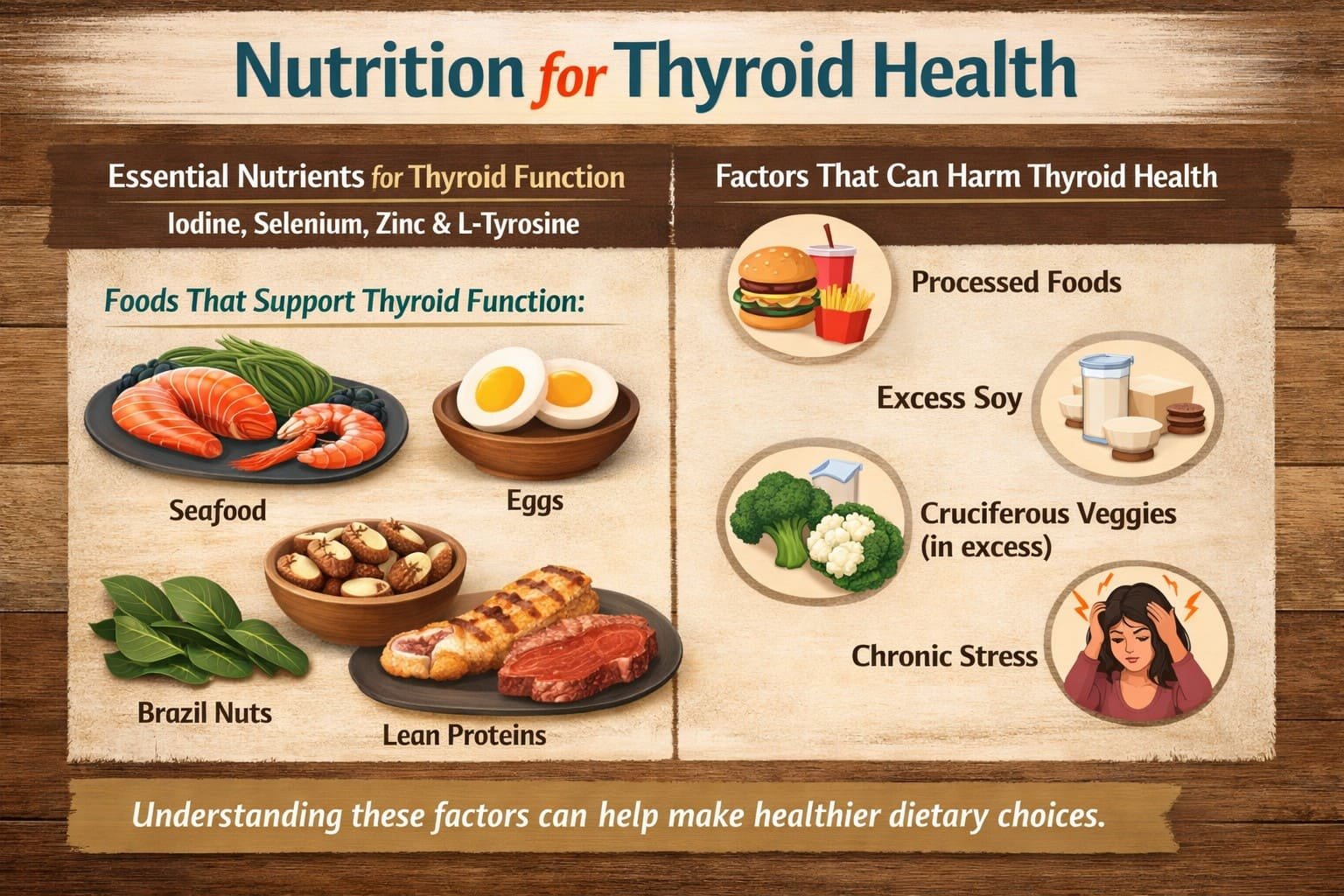
Before getting into specific foods, it helps to understand the key nutrients involved in thyroid hormone production and activation. There are four that matter most:
- Iodine — The raw material used to build thyroid hormones. Both T3 and T4 contain iodine in their molecular structure. Without sufficient iodine, the thyroid literally cannot manufacture its hormones.
- Selenium — Required for the enzyme (deiodinase) that converts inactive T4 into active T3. Without selenium, T4 accumulates but cannot be activated.
- Zinc — Supports thyroid hormone synthesis and helps regulate thyroid-stimulating hormone (TSH) signaling. Zinc deficiency has been linked to reduced T3 and T4 levels.
- L-Tyrosine — The amino acid that forms the backbone of thyroid hormones. Iodine attaches to tyrosine molecules in the thyroid gland to create T3 and T4.
Iron, vitamin D, and B vitamins also play supporting roles in thyroid function, but iodine, selenium, zinc, and tyrosine are the four most directly critical.
The Best Foods for Thyroid Health
1. Seafood — Iodine and Selenium in One Package
Fish and shellfish are among the richest natural sources of both iodine and selenium — the two nutrients most critical for thyroid hormone production and activation. Cod, tuna, shrimp, and salmon are particularly good sources of iodine, while tuna, sardines, and halibut are rich in selenium. For people with thyroid concerns, eating seafood two to three times per week provides a meaningful contribution to both nutrient needs simultaneously.
Oysters deserve special mention: they are one of the highest food sources of zinc available, providing more than 500% of the daily value in a single serving. Zinc supports both thyroid hormone synthesis and TSH regulation, making shellfish a triple-benefit food for thyroid health.
2. Brazil Nuts — The Single Best Food Source of Selenium
Brazil nuts are in a category of their own when it comes to selenium. A single Brazil nut provides approximately 70–90 micrograms of selenium — close to the entire recommended daily intake. Selenium is essential for converting inactive T4 into the active T3 your cells can actually use. Low selenium is one of the most common nutritional factors in impaired T4-to-T3 conversion, particularly in people under chronic stress.
One to two Brazil nuts per day is all that's needed. More than four or five daily on a regular basis risks selenium toxicity — this is one nutrient where more is not better.
3. Eggs — Complete Thyroid Nutrition in One Food
Whole eggs provide iodine (primarily in the yolk), selenium, zinc, and L-tyrosine — covering all four of the thyroid's primary nutritional requirements in a single, affordable food. The yolk is where most of the thyroid-relevant nutrients are concentrated, making whole eggs significantly more valuable than egg whites alone. Two to three whole eggs daily as part of a balanced diet provide consistent thyroid nutritional support without excess.
4. Lean Poultry and Meat — L-Tyrosine and Zinc
Chicken, turkey, and lean beef are excellent sources of L-tyrosine — the amino acid that forms the structural backbone of thyroid hormones. They also provide zinc, which supports thyroid hormone synthesis and helps regulate thyroid function at the hormonal signaling level. For people following high-protein diets, adequate tyrosine intake is rarely a concern. For those eating low-protein diets, thyroid hormone production can be limited by tyrosine availability even when iodine and selenium are sufficient.
5. Dairy Products — Iodine and Tyrosine
Milk, yogurt, and cheese are meaningful sources of both iodine and L-tyrosine in the American diet. Iodine content in dairy varies depending on how the cows are fed and whether iodine-containing sanitizers are used in the dairy process, but cow's milk is consistently one of the top dietary iodine sources for Americans. Greek yogurt, in particular, provides both a good iodine contribution and a substantial protein (and thus tyrosine) content per serving.
6. Seaweed and Nori — Concentrated Botanical Iodine
Seaweed — including nori (used in sushi), kelp, and wakame — contains some of the highest concentrations of natural iodine available in any food. For people who avoid dairy and fish, seaweed is one of the most accessible plant-based iodine sources. However, iodine content in seaweed varies dramatically by type and origin. Kelp in particular can contain extremely high iodine levels that may be excessive for regular daily consumption. Nori and wakame are more moderate and generally safer for regular use.
7. Pumpkin Seeds — Zinc for Thyroid Signaling
Pumpkin seeds are one of the richest plant-based sources of zinc, providing about 20% of the daily value per ounce. For people who don't eat shellfish, pumpkin seeds are one of the most practical ways to maintain adequate zinc levels. They also contain magnesium, healthy fats, and protein, making them a nutritionally dense snack for overall metabolic health.
8. Spinach and Dark Leafy Greens — Iron for Thyroid Function
Iron deficiency is a commonly overlooked contributor to impaired thyroid function. The enzyme thyroid peroxidase — which catalyzes the synthesis of thyroid hormones — is iron-dependent. Without sufficient iron, this enzyme activity is reduced and hormone production declines. Dark leafy greens like spinach, Swiss chard, and kale provide non-heme iron alongside folate and antioxidants. Pairing them with a vitamin C source (lemon juice, tomatoes) significantly improves iron absorption from plant foods.
Foods and Factors That Can Interfere with Thyroid Function
Understanding what to limit is equally important as knowing what to eat. Several dietary factors can impair thyroid hormone production or interfere with medication absorption:
Raw Cruciferous Vegetables in Very Large Amounts
Broccoli, kale, cauliflower, Brussels sprouts, and cabbage contain compounds called goitrogens that can interfere with iodine uptake by the thyroid at very high quantities. This is frequently misunderstood and overstated — moderate consumption of these vegetables is not a problem for most people with normal thyroid function, and cooking deactivates most goitrogenic compounds. However, for people with existing iodine deficiency or known thyroid conditions, consuming very large quantities of raw cruciferous vegetables daily may be worth moderating.
Soy Products in Large Quantities
Soy contains isoflavones that can inhibit thyroid peroxidase activity and potentially interfere with thyroid hormone synthesis when consumed in large amounts with iodine deficiency. Again, moderate soy consumption is not a documented concern for most people. But high-soy diets combined with marginal iodine intake create conditions where thyroid function may be impaired. If you take thyroid medication, soy can also interfere with absorption — maintain a gap of at least four hours between soy products and thyroid medication.
Highly Processed Foods and Refined Sugar
Ultra-processed foods and high sugar intake drive systemic inflammation and can impair thyroid hormone conversion. Chronic inflammation interferes with the deiodinase enzymes that convert T4 to T3, reducing the amount of active thyroid hormone available to cells. A diet that minimizes refined sugar and processed foods reduces this inflammatory burden on thyroid hormone activation.
Excessive Alcohol
Alcohol has been shown to directly suppress thyroid hormone production and impair the body's response to TSH. Chronic alcohol consumption is associated with reduced T3 and T4 levels and can blunt the thyroid's responsiveness to stimulation. Moderate consumption is less concerning, but heavy or regular alcohol intake is a meaningful factor in thyroid suppression.
Coffee and Thyroid Medication
Coffee itself does not harm thyroid function. However, if you take thyroid medication (particularly levothyroxine), coffee can significantly reduce its absorption when consumed close together. Research has shown that coffee taken within 30–60 minutes of thyroid medication can reduce medication absorption by up to 30%. Taking thyroid medication on an empty stomach with water, and waiting at least 30–60 minutes before coffee, is the standard recommendation.
When Diet Alone May Not Be Enough
For most people with healthy thyroid function, a diet that includes regular seafood, eggs, lean proteins, and dairy will provide adequate iodine, selenium, zinc, and tyrosine. But several real-world factors can create gaps:
- Diets that avoid dairy and seafood (vegan or plant-based eating)
- Chronically low protein intake limiting tyrosine availability
- Digestive issues impairing nutrient absorption
- Chronic stress depleting selenium and zinc more rapidly than diet replaces
- Geographic areas with iodine-poor soil and limited dietary iodine sources
In these situations, a targeted thyroid support supplement can help fill the gaps. I've reviewed Thyromine in detail on this site — it combines L-tyrosine, guggul extract (which supports T4-to-T3 conversion), nori as a botanical iodine source, and ginger root in a single daily capsule designed to address the nutritional foundations of thyroid health when diet alone may fall short.
Putting It Together
Thyroid-supportive eating doesn't require a dramatic diet overhaul. The core principles are straightforward: eat enough protein for adequate tyrosine, include regular seafood or dairy for iodine and selenium, add Brazil nuts for concentrated selenium support, and maintain zinc intake through eggs, meat, and pumpkin seeds. Limit excessive raw goitrogens and processed foods, and be mindful of factors that interfere with thyroid medication absorption if you take it.
These dietary foundations support thyroid hormone production and activation in ways that no single supplement can fully replicate — but they also work synergistically with targeted nutritional support when gaps exist. Consistency over weeks and months is what moves the needle on thyroid health, not any single meal or supplement.