
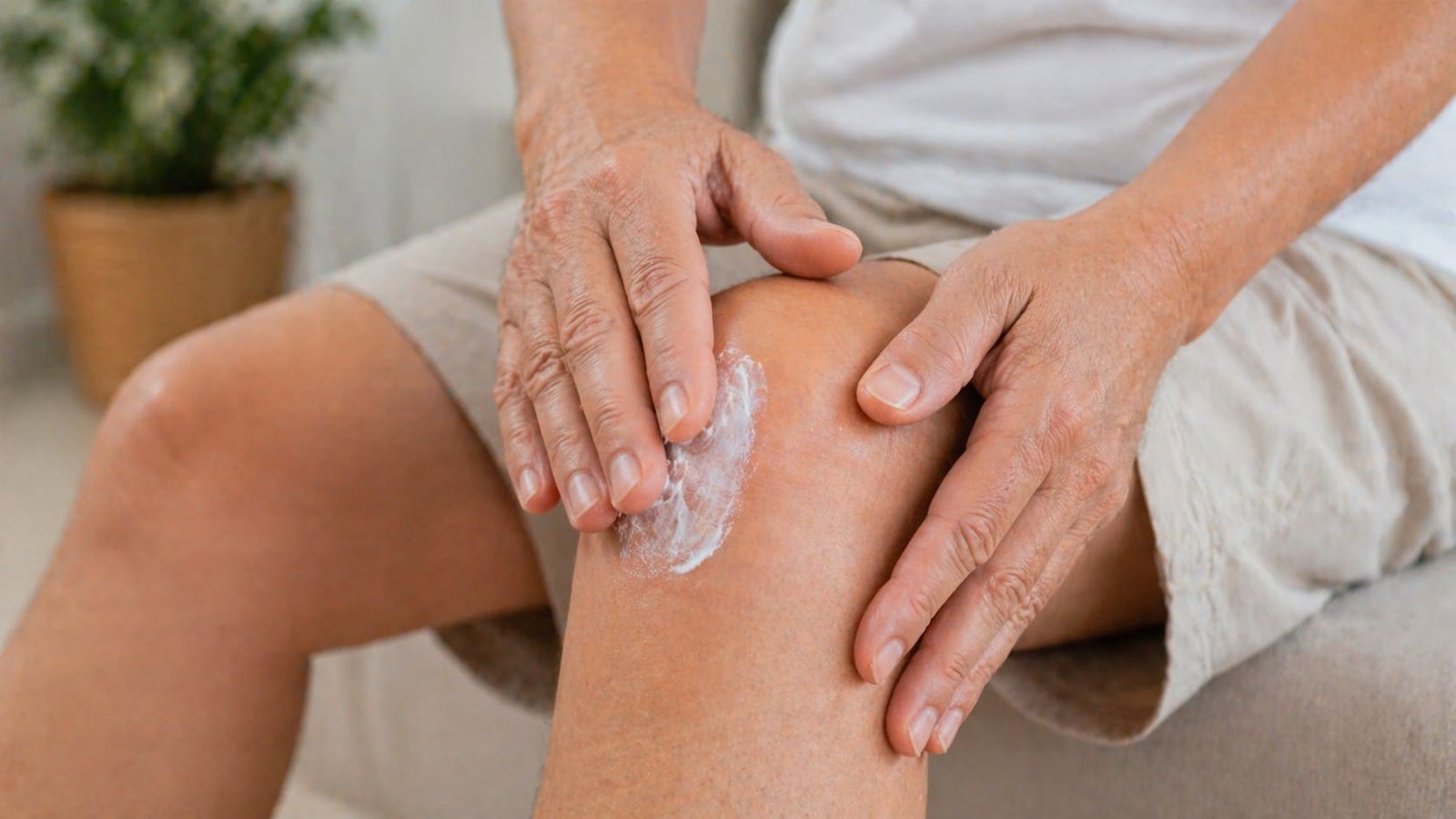
Topical joint creams and gels can deliver meaningful pain relief directly to the source — but not all ingredients are equal. Here's what the research shows about which ones actually work.
Walk into any pharmacy and you'll find an entire aisle dedicated to topical pain relief — creams, gels, patches, balms, and sprays making various claims about joint and muscle pain. The range is enormous, the marketing is bold, and the price points span from a few dollars to well over fifty. For someone dealing with chronic joint pain, navigating this landscape to find something that genuinely works is both important and confusing.
Topical joint pain relief has legitimate clinical advantages over oral alternatives for many users — particularly those who want to avoid the gastrointestinal, cardiovascular, and renal risks associated with long-term oral NSAID use. But the effectiveness of any topical product depends entirely on what is in it, whether those ingredients can actually reach the target tissue at meaningful concentrations, and whether the formula is designed to maximize that delivery.
This article explains how topical joint pain relief works at a mechanistic level, reviews the ingredients with the strongest clinical evidence, and outlines what distinguishes a genuinely effective topical formula from one that provides only superficial sensory relief. If you've already read my article on signs your joints need support, this piece covers the topical treatment dimension of that broader picture.
How Topical Joint Pain Relief Works: The Science of Transdermal Delivery
For a topical product to produce meaningful joint relief, its active compounds need to accomplish something that sounds simple but is biologically challenging: penetrating through multiple skin layers to reach the underlying joint tissue at a concentration sufficient to produce a therapeutic effect.
The skin is the body's primary barrier against the external environment — it is specifically designed to keep substances out. The outermost layer, the stratum corneum, is a tightly packed layer of dead cells embedded in a lipid matrix that repels most water-based compounds. For a topical compound to penetrate, it needs to be either lipid-soluble itself, or be delivered in a vehicle (the cream or gel base) that includes penetration enhancers — compounds that temporarily disrupt the stratum corneum's barrier function to allow deeper penetration.
Research on transdermal drug delivery has established that penetration depth varies significantly between compounds and formulation vehicles. The joint space in superficial joints — knees, wrists, ankles, fingers — is typically 1–3cm below the skin surface, which is achievable for properly formulated lipid-soluble compounds. Deep joints like the hip are 5–10cm below the surface, significantly limiting the effectiveness of topical delivery for those locations.
The Three Mechanisms of Topical Joint Relief
Topical joint products produce their effects through up to three distinct mechanisms, which is why understanding what's in a product matters so much:
- Counterirritant effect — Compounds like menthol, camphor, and capsaicin stimulate sensory receptors in the skin (TRPM8 and TRPV1 channels) to produce cooling or warming sensations that override pain signals in the same area through a process called gate control. This effect is rapid (minutes) but temporary and does not address the underlying joint inflammation or damage.
- Local anti-inflammatory action — Compounds that penetrate to sub-dermal tissue and inhibit inflammatory mediators (prostaglandins, leukotrienes, NF-κB signaling) at the joint level. This is the more therapeutically meaningful mechanism — it addresses the inflammatory process driving pain rather than simply overriding the pain signal. Arnica, NSAIDs (diclofenac), Boswellia, and curcumin work through this pathway.
- Structural joint support — Compounds like Hyaluronic Acid that support the joint's own lubricating mechanisms, reducing friction and improving the mechanical environment within the joint itself. This mechanism is distinct from pain relief and addresses the underlying joint function rather than just symptom management.
A topical product that only provides counterirritant effect is providing sensory distraction. A product that provides local anti-inflammatory action is addressing the cause of pain. A product that additionally supports joint lubrication is going further still. Understanding this hierarchy helps explain why products containing only menthol produce brief, surface-level relief, while more sophisticated formulas can provide sustained, meaningful improvement.
Topical Ingredients With Clinical Evidence for Joint Pain
1. Topical Diclofenac (Prescription/OTC NSAID)
Evidence level: Very strong — multiple RCTs and FDA-approved indication
Topical diclofenac (available as Voltaren Arthritis Pain gel OTC in the US) is the gold standard for topical joint pain evidence. Multiple randomized controlled trials have demonstrated its effectiveness for osteoarthritic knee and hand pain, with a 2012 Cochrane review finding it superior to placebo and producing meaningful pain reduction with minimal systemic absorption — avoiding most of the gastrointestinal and cardiovascular risks of oral NSAIDs. It works by penetrating to the joint space and inhibiting COX-1 and COX-2 enzymes that produce pro-inflammatory prostaglandins. For people who want maximum evidence-based topical NSAID relief, diclofenac gel is the benchmark against which other topical products are measured.
2. Arnica Montana Extract
Evidence level: Strong — multiple human clinical trials
Arnica is the most clinically documented botanical ingredient for topical pain relief. Its active compounds — helenalin and dihydrohelenalin — inhibit NF-κB inflammatory signaling, reducing prostaglandin and cytokine production in inflamed tissue. A systematic review published in Medicines examining 13 clinical trials found topical Arnica produced significant pain reductions in osteoarthritic conditions, with one direct comparison trial finding Arnica gel produced comparable outcomes to topical diclofenac for hand osteoarthritis. A separate trial published in the Journal of Pain Research found significant improvements in pain intensity and hand function from topical Arnica in people with osteoarthritic hands. Its antioxidant flavonoids additionally protect joint tissue from oxidative damage — providing both immediate anti-inflammatory relief and longer-term tissue-protective effects.
3. Topical Hyaluronic Acid
Evidence level: Moderate — human evidence for skin and sub-dermal penetration with joint lubrication effects
Hyaluronic acid (HA) is the primary lubricating molecule in synovial joint fluid — it gives synovial fluid its viscous, gel-like properties that allow cartilage surfaces to glide smoothly. In osteoarthritic joints, HA concentration and molecular weight in synovial fluid are reduced, contributing to increased friction, stiffness, and cartilage degradation. Intra-articular HA injections have strong evidence for symptomatic relief in knee osteoarthritis, delivered directly into the joint space. Topical HA delivery is more limited — larger molecular weight HA does not penetrate deeply, but research has confirmed that low-molecular-weight and nano-particulate HA formulations do reach sub-dermal tissue layers. A study in the Journal of Controlled Release found nano-sized HA particles produced localized anti-inflammatory effects at sub-dermal tissue depth — relevant for the superficial joints where topical delivery is most effective.
4. Capsaicin
Evidence level: Strong — multiple RCTs, FDA-recognized ingredient
Capsaicin — the compound that makes chili peppers hot — produces pain relief through a mechanism that is initially counterintuitive: it activates TRPV1 pain receptors, causing an initial burning sensation, but with repeated application it depletes Substance P — the primary neurotransmitter for transmitting pain signals from peripheral nerves to the brain. With consistent use, capsaicin essentially reduces the pain signal capacity of the treated area. A Cochrane systematic review found high-concentration topical capsaicin produced significant pain relief for neuropathic and musculoskeletal conditions. Low-concentration capsaicin (0.025–0.075%) provides more modest but more tolerable relief. Capsaicin is particularly useful for persistent neuropathic joint pain but requires consistent application over weeks before full effect develops — initial burning is a common reason for early discontinuation.
5. MSM (Methylsulfonylmethane)
Evidence level: Moderate — positive RCTs for joint pain both orally and topically
MSM is an organic sulfur compound with documented anti-inflammatory properties and additional function as a penetration enhancer in topical formulas. A randomized controlled trial published in Osteoarthritis and Cartilage found oral MSM supplementation significantly improved pain and physical function in knee osteoarthritis patients compared to placebo. In topical applications, MSM serves dual roles — contributing anti-inflammatory activity and enhancing the skin penetration of co-administered active compounds. Its sulfur content also provides a substrate for connective tissue repair processes relevant to joint health maintenance.
6. Boswellia Serrata Extract
Evidence level: Moderate to strong — human RCTs for both oral and topical joint pain
Boswellia (frankincense resin) contains boswellic acids that specifically inhibit 5-lipoxygenase (5-LOX) — the enzyme that produces leukotrienes, a class of inflammatory mediators particularly active in joint inflammation. This mechanism is distinct from and complementary to the COX-inhibiting mechanism of NSAIDs and Arnica — together they address both prostaglandin and leukotriene inflammatory pathways simultaneously. A systematic review published in Phytomedicine found Boswellia supplementation produced significant reductions in knee osteoarthritis pain and improved physical function across multiple trials. In topical applications, Boswellia's lipid-soluble boswellic acids penetrate skin effectively, making it well-suited for transdermal delivery.
7. Menthol and Camphor (Counterirritants)
Evidence level: Strong for immediate sensory relief — limited evidence for sustained anti-inflammatory effect
Menthol activates TRPM8 cold receptors in the skin, producing a cooling sensation that competes with pain signals through gate control mechanisms. Camphor activates TRPV1 and TRPA1 receptors, producing a mild warming effect. Both are well-tolerated and produce rapid onset sensory relief that, while not addressing underlying inflammation, provides immediate functional benefit and makes topical products more pleasant to use. They also increase local blood flow, which may improve the penetration of co-administered active compounds into deeper tissue.
What to Look For in a Topical Joint Pain Product
Given the range of products available, several practical criteria help distinguish more effective topical formulas from ones that provide only superficial relief:
- Does it contain anti-inflammatory ingredients beyond counterirritants? A product with only menthol or camphor provides sensory relief but no anti-inflammatory action. Look for Arnica, diclofenac, Boswellia, curcumin, or other compounds that address the inflammatory process directly.
- Does it include a penetration enhancer? Essential oils (Tea Tree, eucalyptus), MSM, and certain alcohol carriers improve the transdermal delivery of other active ingredients. Their presence in a formula suggests it was designed with penetration in mind rather than surface application only.
- Is it formulated for the joint type you're targeting? Lighter, faster-absorbing formulas work better for smaller, more superficial joints (fingers, wrists). Thicker, more occlusive formulas may provide better surface coverage for larger joints like the knee.
- Does the formula include joint lubrication support? Hyaluronic Acid addition targets the mechanical joint environment — reducing friction and stiffness — rather than only the pain signal. This is a meaningful differentiator in more comprehensive formulas.
- Is it free of parabens and synthetic fragrances? These additives serve no therapeutic purpose and can cause skin irritation — particularly relevant for people who need to use a topical product daily over extended periods.
How to Maximize the Effectiveness of Topical Joint Relief
Application technique and timing influence how much active compound reaches the target joint tissue:
- Apply to clean, dry skin — Residual lotions, oils, or sweat on the skin surface reduce penetration efficiency of topical active compounds
- Massage gently until absorbed — Mechanical massage enhances local blood flow and physically works the product into the skin rather than leaving it sitting on the surface
- Apply after warm water exposure — Warm water dilates skin capillaries and slightly opens pores, temporarily improving transdermal penetration. Applying immediately after a warm shower maximizes delivery.
- Use consistently, not just when pain spikes — Anti-inflammatory compounds build up in local tissue with regular use. Sporadic application only when pain is severe produces less sustained benefit than twice-daily consistent application
- Do not apply immediately before showering — Water rinses away product before adequate absorption has occurred. Allow at least 30 minutes post-application before water exposure
- For post-exercise recovery — Apply within 30 minutes of completing activity, while circulation is still elevated from exercise — this is when transdermal delivery efficiency is highest
What Topical Joint Relief Cannot Do
Setting realistic expectations prevents disappointment and ensures topical products are used appropriately within a broader joint health strategy:
- Topical products cannot reverse established cartilage damage — they address pain and inflammation, not structural joint repair
- Deep joints (hip, spine) are largely inaccessible to transdermal delivery — topical products work best on superficial joints within 1–3cm of the skin surface
- Topical products cannot replace the weight management, strengthening exercise, and dietary changes that address the mechanical and metabolic drivers of joint deterioration
- Significant joint disease — advanced osteoarthritis, rheumatoid arthritis, and other systemic inflammatory conditions — typically requires medical management that topical products can complement but not replace
Within these limitations, topical joint relief products occupy a genuinely useful niche: daily comfort support for symptomatic superficial joints, without the systemic side effect concerns of oral medications, as part of a comprehensive joint health strategy.
I've reviewed ArthroMax+ Cream in depth on this site — a formula that combines Arnica Oil, Hyaluronic Acid, Tea Tree Oil (as a penetration enhancer), Boswellia, MSM, curcumin, and menthol in a fast-absorbing, paraben-free base. It addresses pain relief, anti-inflammatory action, joint lubrication support, and penetration enhancement simultaneously — a more comprehensive approach than single-ingredient counterirritant products.
The Bottom Line
Topical joint pain relief is a legitimate and clinically supported approach to managing joint discomfort — particularly for superficial joints, daily use applications, and people wanting to minimize oral medication exposure. Its effectiveness depends entirely on what is in the product and how it is formulated for transdermal delivery.
The best topical joint formulas go beyond counterirritants to include anti-inflammatory compounds with genuine clinical evidence, penetration enhancers that improve delivery depth, and ideally joint lubrication support that addresses the mechanical dimension of joint discomfort alongside the inflammatory one. Applied consistently and correctly, they provide a practical, targeted component of a comprehensive joint health protocol.