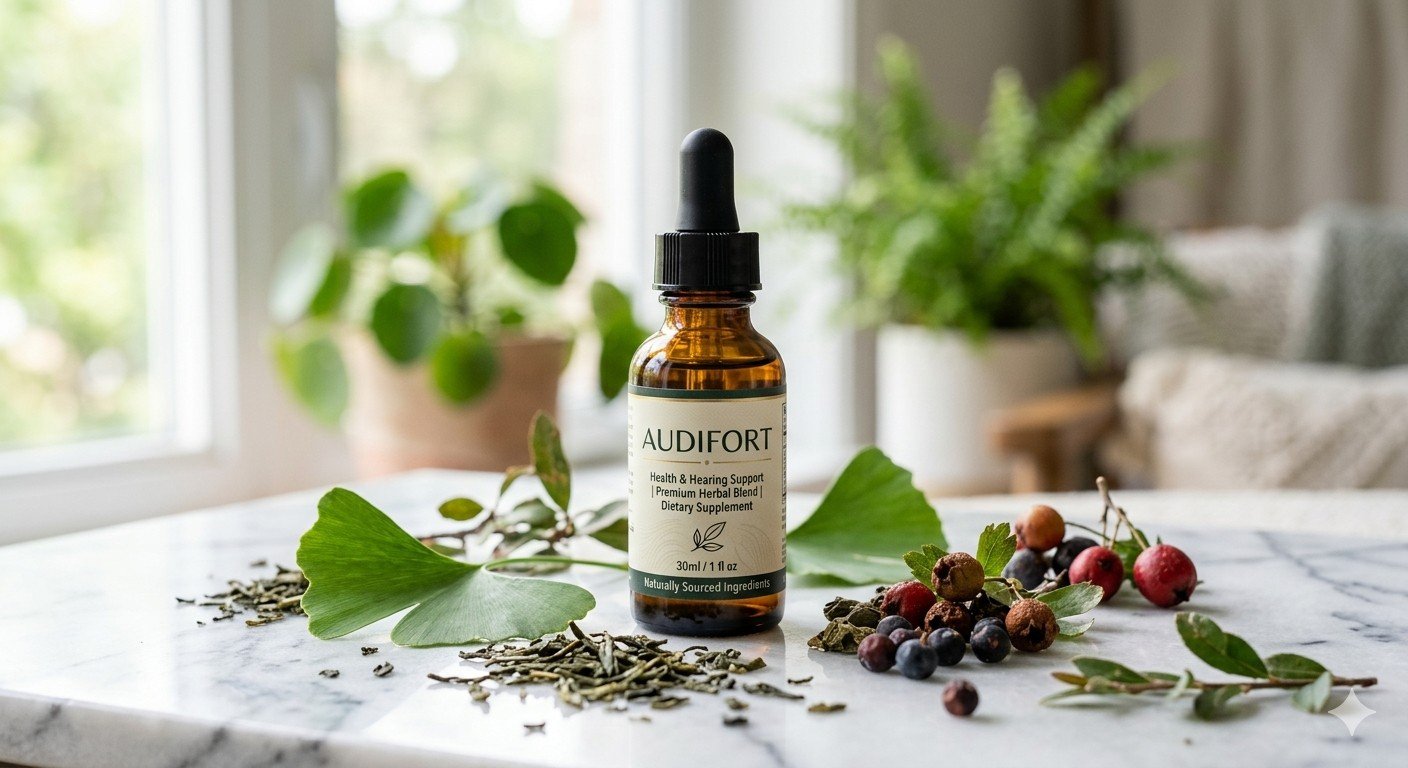
Audifort is sold as a hearing-support formula, but what is actually inside the drops — and does research back any of it? This breakdown walks through each audifort ingredient individually, grades the strength of evidence behind each one, and identifies what the formula is missing so you can decide with your eyes open rather than your hopes up.
We are an independent research desk led by health researcher James Hartwell, and we grade supplement formulas by one measure: published evidence, not promises. For every audifort ingredients entry below we note the study level behind it — solid, preliminary, or animal-only — because these terms do real work. A compound with randomized human trials behind it and one with data from mice are separated by a decade of research distance, and supplement marketing collapses that gap deliberately.
What Is Inside Audifort?
Based on the brand's own published formula, Audifort contains six headline active compounds delivered as liquid drops: ginkgo biloba extract, zinc, magnesium, vitamin B12, alpha lipoic acid, and green tea extract standardized for EGCG. The concept behind the blend is coherent: support cochlear blood flow, protect auditory cells from oxidative stress, and cover nutrient deficiencies that are clinically linked to hearing and tinnitus problems.
One transparency note before we begin: the brand does not publish exact dosages or third-party certificates of analysis (COAs) on its website, so our ingredient-by-ingredient review evaluates the compounds themselves, not the specific amounts in the bottle. That limitation runs through everything below, and it is the same limitation that applies to most direct-to-consumer supplements.
Audifort Ingredients, One by One
1. Ginkgo Biloba Extract — Evidence Level: Mixed Human (Preliminary for Tinnitus)
Ginkgo biloba is the most studied herbal ingredient in the hearing category, and its inclusion here is reasonable rather than exotic. Published reviews, including work in the Journal of Ethnopharmacology, document its effect on microcirculation — directly relevant, since the cochlea is a blood-hungry structure and reduced inner-ear blood flow is implicated in age-related auditory decline.
For tinnitus specifically, human evidence is genuinely mixed: some analyses of standardized ginkgo extracts report reduced tinnitus severity in certain populations, particularly where circulatory factors are involved, while other trials find no significant benefit versus placebo. We would call this ingredient plausible but not proven — one of the better-reasoned picks for the formula's purpose, with the honest caveat that individual response is uneven.
2. Zinc — Evidence Level: Solid in Deficiency, Preliminary Otherwise
Zinc is the ingredient with the clearest, most defensible logic. The inner ear contains some of the highest zinc concentrations in the human body, deficiency has been clinically associated with hearing loss and tinnitus, and research published in the American Journal of Otolaryngology reported measurable improvement in tinnitus symptoms among zinc-deficient patients who received supplementation.
The qualification that matters: the strongest data applies to people who were deficient to begin with. Zinc status declines with age, and older adults are the group most likely to benefit. For someone with adequate zinc levels, we would not expect this ingredient to add much. We grade it solid where deficiency exists, unremarkable where it does not.
3. Magnesium — Evidence Level: Solid for Noise Protection
Magnesium earns its place with some of the more compelling research in the category. Studies published in the American Journal of Otolaryngology showed that magnesium supplementation helped preserve hearing function in subjects exposed to loud noise — a mechanism researchers attribute to protecting the cochlea's delicate hair cells against oxidative and excitatory stress.
Two honest limits. That protective evidence is strongest in the noise-exposure context (loud workplaces, concerts, headphones) rather than in reversing existing decline. And it is prevention-oriented: magnesium appears to shield hair cells during stress, not repair them after death. We grade it solid for protection, preliminary for restoration.
4. Vitamin B12 — Evidence Level: Preliminary (Deficiency-Linked)
B12 deficiency is more common in older adults, in long-term users of metformin, and in people on plant-based diets — overlapping substantially with supplementation's target audience. Low B12 has been associated with tinnitus and with impaired auditory processing in research published in the American Journal of Clinical Nutrition, and B12 supports the nerve conduction that carries sound signals from the cochlea to the brain.
The evidence level, stated plainly: these are largely correlational associations, not trials showing that B12 supplementation restores hearing in non-deficient people. For anyone actually deficient, correction is medically sensible and hearing-relevant symptoms sometimes improve. We grade it preliminary, deficiency-dependent.
5. Alpha Lipoic Acid — Evidence Level: Preliminary (Mostly Preclinical)
Alpha lipoic acid is an antioxidant with a property that makes it theoretically interesting for hearing: it crosses both the blood-brain barrier and the blood-cochlear barrier, reaching inner-ear tissue directly. Research highlighted in journals such as Antioxidants & Redox Signaling describes neuroprotective effects in sensory systems, and oxidative damage to auditory hair cells is one of the better-documented mechanisms of age-related hearing decline.
But the honest grading: most of the relevant data is from animal and laboratory models, with human evidence in hearing specifically still thin. We grade it promising but unproven — a fair inclusion in a modern formula, not a validated treatment.
6. Green Tea Extract (EGCG) — Evidence Level: Animal
Epigallocatechin gallate (EGCG), the primary active compound in green tea, has broad antioxidant and anti-inflammatory research behind it. Work published in Free Radical Biology and Medicine found EGCG may reduce oxidative stress in cochlear tissue — relevant to slowing degeneration that accumulates over decades.
The evidence level here is the weakest in the formula: cochlea-specific findings are largely from animal and cell studies, with humans drinking tea and taking extracts studied for other outcomes. We grade it animal-level — plausible background support rather than a hearing intervention.
What the Combined Formula Can and Can't Claim
Taken together, the audifort ingredients earn a fair grade of "reasonable formula, unproven product." Every compound has at least preliminary published support for a hearing-relevant mechanism, and zinc, magnesium, and ginkgo have genuine human data in specific contexts. No compound on the list is embarrassing or pseudoscientific — which distinguishes Audifort from formulas built on vague "ear support blends."
What the formula cannot claim is anything stronger. The exact Audifort blend has never been tested in a randomized controlled trial. Individual studies examine single compounds, usually at published doses, usually in defined populations. A blend without disclosed doses is not automatically the sum of its researched parts — dosing is where many supplement formulas quietly fail, and it is the question we cannot answer from the label alone.
See Audifort's Official Store →
What's Missing From the Formula (and the Label)
- Published dosages: the brand does not disclose exact amounts of each compound, so buyers cannot compare the formula against the doses used in the studies above — the most significant gap in our view
- Third-party certificates of analysis: no COAs are prominently displayed, so purity and potency claims rest on the manufacturer's word
- A formula-level clinical trial: no independent RCT of the combined blend exists, so claims about the finished product rest entirely on ingredient-level inference
- Certain quality markers: some competing hearing formulas include compounds like coenzyme Q10 or folate with their own preliminary hearing research; their absence is a design choice, not a defect, but it narrows the "everything in one bottle" pitch
None of those gaps makes the product a scam — we address the legitimacy question separately in our piece on whether Audifort is a scam. They cap the strength of every claim that can honestly be made about it.
Who Is Most Likely to Benefit From These Ingredients?
Because the evidence is deficiency- and mechanism-dependent, the beneficiaries are predictable:
- Older adults with low zinc or B12 status: where deficiency exists, correction has the clearest human evidence in this formula
- People with circulation-related hearing complaints: ginkgo's microcirculation data gives this group the best theoretical match
- Anyone with heavy noise exposure: magnesium's protection data is prevention-oriented, so it favors people still exposing their ears to risk
- Not those with structural damage: no audifort ingredient regenerates destroyed hair cells or repairs the auditory nerve — any claim otherwise is marketing noise
Verdict on Audifort Ingredients
Our final assessment of the audifort ingredients: the formula is credibly assembled around real hearing-relevant mechanisms — cochlear circulation, antioxidant protection, nutrient correction, and nerve support — and it avoids the mystery-blend pseudoscience that plagues much of this category. Evidence behind individual compounds ranges from solid (zinc in deficiency, magnesium for noise protection) through preliminary (ginkgo for tinnitus, B12, ALA) to animal-only (EGCG). The product itself, as a specific blend with undisclosed doses, remains unproven, and that distinction should shape your expectations.
If you decide to try it, judge results against the 60–90 day timeline the underlying research implies, buy through the official website so the 90-day money-back guarantee covers you, and check the current formula and terms yourself before ordering. Supplements work in the margins of hearing health; nothing in this bottle replaces an audiological evaluation.
See Audifort's Official Store →
For the big-picture evaluation, read our updated Audifort review for 2026 or our consolidation of real customer feedback and complaints.