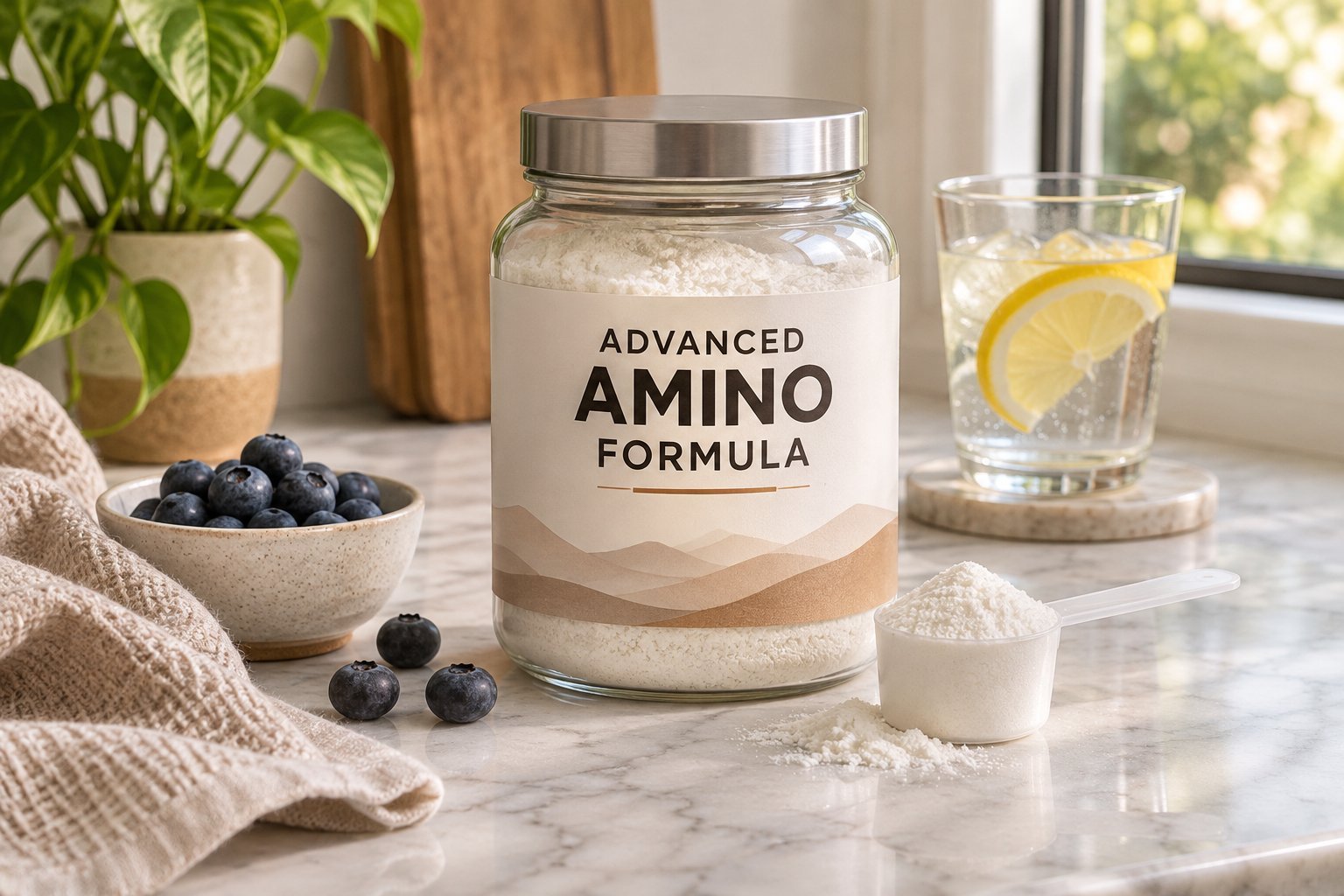
Short answer first: these three supplements are not really competitors — they pull three different levers. Creatine monohydrate is the best-evidenced strength builder per dollar, hands down. HMB targets the breakdown of muscle you already have. Advanced Amino Formula supplies the raw material for building new muscle protein. After 50, your goal determines which of the three deserves your budget.
We compared all three the way we would advise a family member: on mechanism, on the weight of the evidence, on real daily cost, and on who each one actually suits. No hype, no invented lab numbers — and where the evidence is mixed, we say so.
What Are These Three Supplements Actually Doing?
Creatine monohydrate works on your energy system. Your muscles burn phosphocreatine for short, explosive efforts; supplementing raises those stores, which lets you train harder and heavier. The muscle gain follows the harder training. It is arguably the most heavily researched supplement in existence, and in adults over 50 it is one of the few with strong human evidence for supporting strength and lean mass when paired with resistance exercise.
HMB (beta-hydroxy beta-methylbutyrate) is a metabolite of leucine that aims to slow muscle protein breakdown. Its evidence is more uneven than creatine's: some trials in untrained older adults and in people at risk of muscle disuse show preserved mass, while larger analyses find modest effects at best. It is a niche tool — the honest reading is "may help, not proven dramatic."
Advanced Amino Formula attacks the problem from the supply side. It delivers 5,000 mg of all eight essential amino acids — including leucine, HMB's parent compound — in five tablets. Essential amino acids are the literal building blocks of new muscle protein, and complete EAA blends have solid human evidence for triggering muscle protein synthesis in older adults, especially around exercise. The company claims the blend tests at 99% protein utilization; that specific figure is company-reported and unverified, though the underlying role of EAAs is not controversial.
A dose note worth having before you compare price tags. Creatine works at 3 to 5 grams a day, every day, and responds to total weekly consistency far more than to timing. HMB is studied around 3 grams a day. Advanced Amino Formula's serving is 5 tablets delivering those 5 grams. None of the three requires a loading phase to be useful, and none works selectively on one body part. Whatever you buy, the honest variable is whether you will still be taking it in month three, because that is where results in this age range actually come from.
How We Ran This Comparison
Transparency matters when a review page earns a commission on one of the products. Here is the method: we read the Advanced Amino Formula supplement-facts label and the Advanced Bionutritionals product and sales pages directly, we price-checked the official bundle tiers, and we weighed each supplement against the published evidence base from sports-nutrition research — not against the other ingredient lists. What we refused to do: invent lab numbers, quote testimonials that the official pages do not actually publish, or present a company's own claim as established science. Where the marketing makes a specific assertion — the 99% utilization figure, the 83%-of-whey-becomes-sugar figure — we label it as a company-reported claim, not a fact of record.
The one limit we cannot engineer around: we found no published trial that puts EAAs, creatine, and HMB head-to-head in the same aging cohort. The comparison below is a reasoned synthesis of three separate evidence bases, and any reviewer who tells you otherwise is describing a study that does not exist.
See the Official Advanced Bionutritionals Store →Which One Has the Strongest Evidence After 50?
- Creatine: the deepest evidence base of the three. Decades of human trials, multiple consensus statements, and specific research in older adults. If we ranked by confidence, creatine is first.
- Complete EAA blends: solid for stimulating muscle protein synthesis, which is the rate-limiting step when protein intake falls short — a common problem after 50. Leucine's signaling role is well established.
- HMB: mixed to modest. Worth considering in very specific situations — recovery from surgery, injury, or periods of forced inactivity — not as a general mass builder.
A fair note on Advanced Bionutritionals' own framing: the product pages argue whey powder protein is largely wasted and BCAA-only products are missing five building blocks. The second point is well supported — BCAA-only supplements lack the amino acids the body needs to complete new protein. The first point, the 83%-to-sugar figure for whey, is a contested company claim, not settled science. Treat it as their argument, not a fact.
What Does Each One Cost Per Day?
Cost is where these three really separate.
- Creatine monohydrate — plain powder typically runs pennies a day at an effective 3-5 gram dose. It is close to the cheapest legal performance supplement you can buy.
- Advanced Amino Formula — the official site prices a one-month bottle at $39.95, which the company itself describes as about $1.33 a day. Bundles drop it: $35.95 per bottle for three months, or $33.25 per bottle for six months with free shipping. Pricing varies by bundle on the official site.
- HMB — effective daily doses are around 3 grams, and free-form leucine derivatives cost more per gram than creatine. Expect to pay meaningfully more per day than creatine, though price varies widely by brand.
So on raw cost: creatine wins by a wide margin, Advanced Amino Formula sits in the mid-range for a premium small-batch product, and HMB is the awkward middle — pricier than creatine without its evidence base.
So Which One Should You Take After 50?
Pick by your actual situation, not by advertisement:
- You train with weights and want measurable strength gains. Creatine monohydrate first. It multiplies what progressive training produces and costs pocket change.
- You under-eat protein, have a small appetite, or eat mostly plants. This is Advanced Amino Formula's home turf. The complete EAA blend covers exactly the gap — including the leucine that triggers synthesis — in a swallowable, vegan, allergen-light format. This is also where older adults' digestion argument carries the most weight.
- You are facing forced downtime — an injury, surgery, or weeks off your feet. HMB has the most targeted research for protecting muscle during disuse, modest as the effect may be.
- You want to stack rather than choose. Nothing in the three conflicts. Buyers do combine them — one 70-year-old verified reviewer on the official page credits "Advanced Amino Formula in combination with creatine gummies" with stopping his muscle mass loss and rebuilding strength. His results, like anyone's, may not match yours.
A Note on After-50 Muscle Loss That No Supplement Fixes Alone
One more variable, because it changes the buying decision for a lot of readers: hormones. The natural drop in testosterone and estrogen after 50 slows muscle protein synthesis independently of what lands on your plate. If your strength has been declining faster than your training has softened, the right first move may be a lab conversation with your doctor rather than any bottle in this comparison — and for readers exploring the natural-support angle, our guide to the best herbs for testosterone support reviews the evidence that actually exists for botanicals, which is considerably thinner than the marketing around them implies.
None of this is a reason to skip amino acids or creatine. It is a reason to notice when a supplement subscription pitch is being sold as a replacement for medical follow-up. The honest stack after 50 is usually boring: progressive lifting, protein at every meal, sleep, a physician who checks your numbers, and at most one or two supplements whose mechanisms you can actually explain.
Where Advanced Amino Formula Beats the Other Two — and Where It Does Not
Its genuine advantages: complete spectrum (no missing building blocks), a verified-clean allergen label, no mixing or refrigeration, and a 90-day money-back guarantee that lets you run a real self-trial. Its real disadvantages: it costs more per day than creatine by roughly an order of magnitude, it does nothing for the phosphocreatine energy system that powers heavy lifts, and five tablets a day is more daily friction than a scoop stirred into coffee.
There is also a value-for-money question we leave to your own convictions: the company sells a small-batch, quality-control-heavy product at a boutique price, and a generic complete-EAA blend would match the mechanism for less. What you would lose is the 90-day guarantee and the brand's stated QC process, which is more than nothing — but it is a trade-off, not a technical edge.
Our Verdict
Additional safety notes worth their own paragraph: creatine is well tolerated in healthy adults but needs adequate hydration, and people with existing kidney disease should clear any of these with their physician first — that caution applies to a protein-heavy amino regimen as much as to creatine itself. HMB has a clean tolerance record in trials. Advanced Amino Formula's own label carries the PKU restriction we flagged above. None of the three carries an FDA disease claim, and all three ship the same honest disclaimer underneath the marketing.
If you will only spend in one place and you lift weights: buy creatine, and spend the savings on groceries — protein-rich food does more than clever supplements. If your problem is getting enough usable protein into a smaller, older, or plant-based appetite: Advanced Amino Formula is a legitimate, clearly labeled way to do it, and the guarantee makes a one-bottle test nearly risk-free. If you are heading into forced inactivity: talk to your doctor about HMB. And if you are over 50 and serious about keeping your muscle long-term, read our full Advanced Amino Formula review, and for the other side of the ledger, the real buyer complaints, before spending a dollar.
Check Current Advanced Amino Formula Pricing →