Nerve Fresh sells itself as a plant-based formula for neuropathy support, and the ingredient list is the only part of the pitch worth trusting. Our verdict up front: the formula contains three genuinely interesting components — Acetyl-L-Carnitine, the most clinically studied nutritional compound for neuropathic pain; Prickly Pear betalains for oxidative stress; and Corydalis, an intriguing but under-proven pain-signaling blocker — plus one foundational ingredient (B12 methylcobalamin) and, notably, one conspicuous omission: no alpha-lipoic acid, the most researched over-the-counter compound in this entire category.
This is our evidence check on each ingredient. We assign every component an evidence level — solid (human clinical evidence specific to the claim), preliminary (human or mechanistic evidence but thin or indirect), or animal (promising but not demonstrated in humans) — and we flag what the formula leaves out. We're independent researchers, not the manufacturer's copy desk; where the marketing gets ahead of the science, we say so.
What's Actually in Nerve Fresh
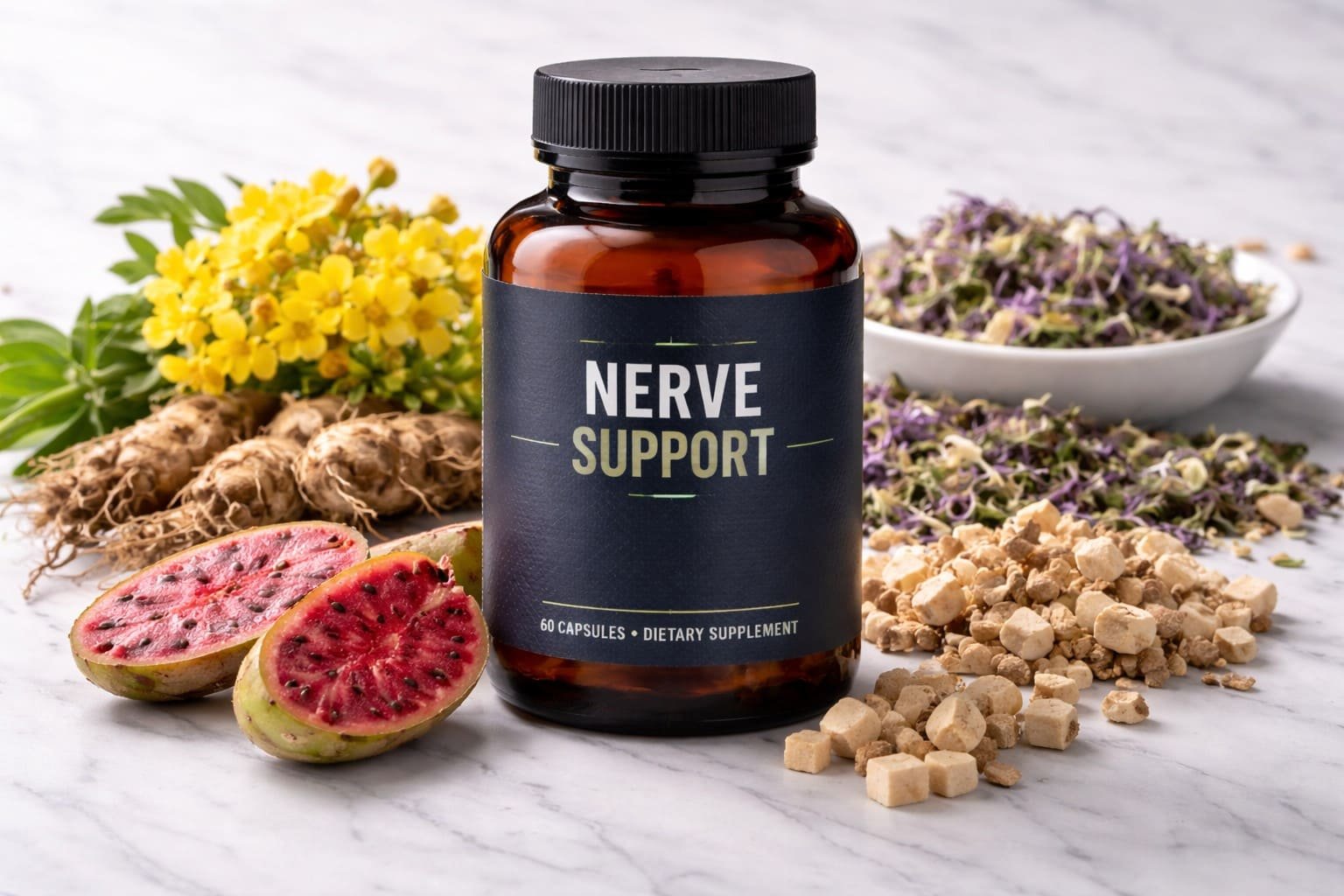
Per the manufacturer, Nerve Fresh contains eight active components in a plant-based, non-GMO, gluten-free capsule, dosed at two capsules daily:
- Corydalis (Corydalis yanhusuo)
- Prickly Pear (Opuntia ficus-indica)
- Passionflower (Passiflora incarnata)
- Marshmallow Root (Althaea officinalis)
- California Poppy (Eschscholzia californica)
- Acetyl-L-Carnitine
- Vitamin B12 (as methylcobalamin)
- Magnesium
One transparency note before the analysis: the sales pages we reviewed do not publish a complete supplement facts panel with per-ingredient amounts. That matters, because an ingredient list proves nothing by itself — 5 mg of a studied compound and 500 mg produce very different results. Ask the seller for the full label before you buy, and treat any formula that won't show it with suspicion. The analysis below grades the ingredients, not the dosing we couldn't verify.
Ingredient-by-Ingredient Evidence Check
1. Corydalis — evidence level: animal (promising)
Corydalis is the formula's differentiator. Its principal bioactive, dehydrocorybulbine (DHCB), was isolated and studied by UC Irvine researchers and published in Current Biology: in animal models, DHCB blocked both inflammatory and neuropathic pain by acting on dopamine D2 receptors — a non-opioid, non-addictive pain-modulation pathway. Hundreds of years of Traditional Chinese Medicine use as an analgesic back the folk side of the ledger.
How we grade it: the mechanism is legitimate and the direction is promising, but DHCB has not been demonstrated in human neuropathy trials at supplement-scale doses. Corydalis is the ingredient most likely to be oversold by affiliate pages and most deserving of your skepticism. Mechanism: pain signal blocking.
2. Prickly Pear — evidence level: solid (for inflammation markers)
Prickly Pear cactus fruit is dense in betalains, a class of antioxidant pigments. Human research published in the Journal of Nutritional Science found that Prickly Pear extract significantly reduced inflammatory markers and oxidative stress biomarkers — human trials, human outcomes.
How we grade it: solid evidence for the anti-inflammatory and antioxidant effects themselves. The nerve-specific inference — that reducing oxidative stress slows the myelin damage seen in diabetic and aging-related neuropathy — is biologically coherent but not yet demonstrated for this formula. Mechanism: inflammation and oxidative stress.
3. Passionflower — evidence level: solid (anxiety, sleep)
Passionflower is a well-established nervine whose primary mechanism enhances GABA activity, calming the neural hyperexcitability that amplifies pain perception. Human clinical research published in Phytotherapy Research supports its use for reduced anxiety and improved sleep quality.
How we grade it: solid for what it actually does — calming and sleep. Both matter enormously in neuropathy, where pain is characteristically worse at night and sleep loss feeds back into pain sensitivity. Nobody should pretend it regrows nerves; the claim it can support is narrower and better evidenced. Mechanism: nervous system calming.
4. California Poppy — evidence level: preliminary
California Poppy contains alkaloids (californidine, eschscholtzine) that interact with GABA receptors and produce mild analgesic and sedative effects — without the dependency profile of its opioid-poppy relative. Clinical research documents reduced anxiety, improved sleep, and calming of overactive nerve signaling, though the bulk of the strongest work is preliminary or in animals.
How we grade it: preliminary but sensible alongside Passionflower. The two herbs form the formula's coherent "night shift" — targeting the hours when neuropathy causes the most misery. Mechanism: nervous system calming, mild analgesia.
5. Acetyl-L-Carnitine — evidence level: solid (the strongest in the formula)
ALC is the ingredient a skeptical analyst takes most seriously. Multiple randomized controlled trials — including a Cochrane-reviewed meta-analysis — found ALC supplementation produced meaningful reductions in neuropathic pain and improvements in nerve fiber density versus placebo. The mechanism is mitochondrial: neurons are extraordinarily energy-hungry, and impaired energy metabolism in peripheral nerves is a documented contributor to neuropathic symptoms. ALC also supports acetylcholine synthesis and nerve fiber growth.
How we grade it: solid — human trials, in neuropathy, with structural endpoints. If the dosing turns out to be adequate, this single ingredient changes the math on the whole product. Mechanism: nerve cell energy, nerve regeneration support.
6. Vitamin B12 (methylcobalamin) — evidence level: solid (deficiency-related neuropathy)
B12 deficiency is one of the most common and most correctable causes of peripheral neuropathy, and B12 is essential for myelin — the fatty sheath around nerve fibers that makes signal transmission possible. Deficiency risk concentrates in adults over 50 (reduced gastric acid impairs absorption), vegans and vegetarians, metformin users, and long-term proton pump inhibitor users. Methylcobalamin is the neurologically active, more bioavailable form rather than cheap cyanocobalamin.
How we grade it: solid — correcting a deficiency is the best-established nutritional intervention in neuropathy, full stop. The caveat: it works where deficiency exists. If your B12 labs are fine, this ingredient does less for you. Mechanism: myelin sheath maintenance.
7. Magnesium — evidence level: mixed
Magnesium regulates NMDA receptors — the same receptors involved in central pain amplification — and supports the electrical stability of nerve cell membranes. Deficiency is associated with increased nerve excitability and heightened pain sensitivity, and some research links magnesium supplementation to reduced neuropathic pain in diabetic patients. Roughly half of Americans fall short on intake.
How we grade it: mixed but practical. Not a headline ingredient; a reasonable baseline that most adults are quietly missing anyway. Mechanism: nerve signal transmission, excitability.
8. Marshmallow Root — evidence level: preliminary (supporting role)
A demulcent herb — high in mucilage, traditionally used to soothe irritated tissue. In this formula it plays two supporting roles: reducing systemic inflammation that aggravates nerve irritation, and potentially enhancing the bioavailability of the other botanical extracts.
How we grade it: preliminary, and fine. It's a supporting player, and it earns its slot only insofar as the headline ingredients are dosed well. Affiliate pages that make Marshmallow Root sound like a nerve healer are overselling it. Mechanism: inflammation (support).
Three Mechanisms, One Scorecard
Mapping the formula to the mechanisms that actually drive neuropathy:
- Myelin: B12 methylcobalamin is the sole myelin-directed ingredient, and it's the right one — strong evidence where deficiency exists. ALC adds structural support for nerve fiber growth.
- Inflammation and oxidative stress: Prickly Pear carries the human evidence; Marshmallow Root supports at a lower tier. This axis is reasonably covered.
- Circulation and nerve energy: the formula's weakest frontier. ALC addresses nerve cell energy directly, but there is no dedicated circulation ingredient in the list — no ginkgo, no omega-3s, nothing vascular. In diabetic neuropathy, where microvascular damage starves peripheral nerves, that's a real coverage hole.
- Pain signaling and hyperexcitability: Corydalis (promising, unproven in humans), Passionflower and California Poppy (evidence for calming, not for pain per se). Coverage is real but the least proven axis in the formula.
What's Missing From Nerve Fresh
No formula is complete, but three omissions stand out for a neuropathy audience:
- Alpha-lipoic acid. The most studied OTC compound in diabetic neuropathy, with the largest human trial base in the category. Its absence is the formula's most conspicuous gap.
- Benfotiamine (fat-soluble B1). Early-stage clinical support in diabetic neuropathy and a standard fixture in serious nerve formulas. Also absent.
- Dose transparency (or the lack of it). Without a public supplement facts panel, no one outside the manufacturer can confirm the formula is dosed at research-supported amounts. Get the label before you spend a cent.
None of this makes Nerve Fresh a bad formula — it makes it a partial one. If you want maximum mechanism coverage, there's no rule against adding a separate ALA or benfotiamine supplement alongside it, provided your physician signs off on the total regimen.
Bottom Line: What the Ingredient List Really Tells You
Nerve Fresh is built around a defensible idea — supplement the nutritional and anti-inflammatory foundations, then attack pain signaling and hyperexcitability with botanicals — and its strongest components (ALC, methylcobalamin B12, Prickly Pear) carry the best evidence in the bottle. Its boldest component (Corydalis) is the furthest from proven. What the list can't tell you is dosing, and dosing is where supplement marketing most often disappears. Our advice in order: get the label, run it past your doctor alongside any medications, and judge results on a 60-day clock rather than hype's five-day one.