An honest, research-based assessment of which herbs actually have clinical evidence for supporting testosterone and male vitality — and which are mostly marketing.
The natural testosterone supplement market is worth billions of dollars and is populated by hundreds of products making bold claims. Virtually every product in the category names an impressive-sounding list of herbs, roots, and botanical extracts on its label. The challenge for any man trying to navigate this space is distinguishing which of these compounds have genuine published clinical evidence behind them — and which are present largely because they sound exotic and cost very little to include in a formula.
The honest answer is that the evidence landscape is uneven. Some herbs have multiple well-designed randomized controlled trials in humans showing meaningful effects on testosterone, libido, and male vitality. Others have compelling mechanisms in cell or animal studies but minimal human evidence. And some have little more than traditional use and aggressive marketing behind them.
This article provides a research-based assessment of the most commonly cited herbs for testosterone support — examining the actual evidence for each, explaining the mechanisms through which they work, and clarifying what realistic expectations look like. If you've already read my articles on the signs of low testosterone and how to increase testosterone after 40, this article completes the picture of natural botanical options within that strategy.
What Herbs Can — and Cannot — Do for Testosterone
Before examining individual compounds, it is worth setting an accurate frame of reference. No herb will produce testosterone levels equivalent to medically prescribed testosterone replacement therapy. Herbs work within the body's existing hormonal production capacity — they support, optimize, and in some cases meaningfully enhance natural testosterone production, but they don't introduce testosterone from outside the body the way pharmaceutical TRT does.
This means herbs are most relevant for men whose testosterone is suboptimal due to addressable factors — stress, nutritional deficiencies, impaired LH signaling, excessive SHBG binding, or elevated aromatase activity from visceral fat. For men with clinically low testosterone caused by testicular failure or pituitary dysfunction, herbs will produce limited results and medical management is the appropriate intervention.
Within their appropriate context, however, several herbs produce documented and clinically meaningful effects on testosterone and male hormonal health. Understanding which ones and why gives men a far more useful framework than simply trusting supplement labels.
Herbs with Strong Clinical Evidence
1. Tongkat Ali (Eurycoma Longifolia)
Evidence level: Strong — multiple human RCTs
Primary mechanisms: LH stimulation, SHBG reduction, cortisol inhibition
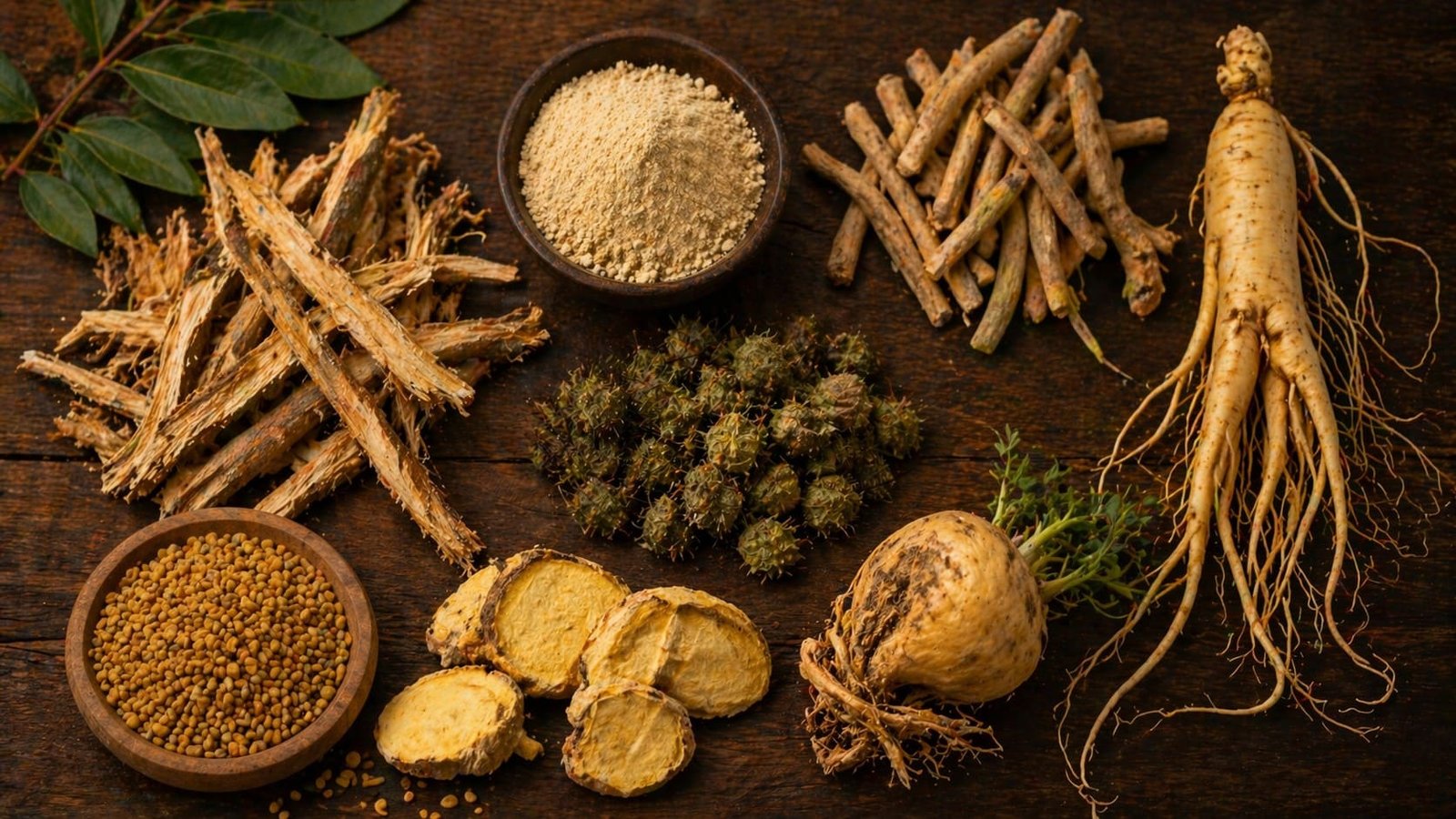
Tongkat Ali — also called Longjack or Malaysian Ginseng — is the herb with the strongest overall evidence base for testosterone support among natural botanicals. Its bioactive compounds (eurycomanone and related quassinoids) work through multiple mechanisms simultaneously. They stimulate luteinizing hormone (LH) release from the pituitary, which directly signals the testes to produce more testosterone. They reduce sex hormone binding globulin (SHBG), which increases the proportion of testosterone that remains free and biologically active. And they inhibit cortisol, removing one of testosterone's primary antagonists.
A randomized, double-blind, placebo-controlled trial published in the Journal of the International Society of Sports Nutrition found that Tongkat Ali supplementation produced significant increases in total testosterone, free testosterone, and muscle strength in men with low testosterone over 5 weeks. A 2022 systematic review in Nutrients examining 11 clinical trials consistently found positive effects on testosterone, sexual function, and male fertility. The research also shows benefits in men under chronic stress — where cortisol suppression of testosterone is a primary driver of symptoms — making it particularly relevant for men whose low testosterone is stress-related.
Effective dose: 200–400mg daily of standardized extract (containing eurycomanone). Quality and standardization vary significantly between products — look for extracts specifying eurycomanone content.
2. Ashwagandha (Withania Somnifera)
Evidence level: Strong — multiple human RCTs
Primary mechanisms: Cortisol reduction, HPG axis support, direct testicular support
Ashwagandha is one of the most clinically studied adaptogens and has some of the strongest human evidence for testosterone support of any botanical compound. Its withanolide compounds reduce cortisol through multiple pathways — inhibiting the enzyme 11β-HSD1, modulating HPA axis reactivity, and reducing systemic inflammatory load that drives cortisol elevation. Since cortisol directly suppresses testosterone production at the hypothalamus, pituitary, and testicular levels, reducing cortisol reliably supports testosterone.
A double-blind, randomized, placebo-controlled trial published in Medicine found that KSM-66 Ashwagandha supplementation for 8 weeks produced a 15% increase in testosterone and a 27% reduction in cortisol compared to placebo. A separate trial in the Journal of the International Society of Sports Nutrition found significant improvements in muscle strength, size, and recovery alongside hormonal changes. Additional research has documented Ashwagandha's direct effects on testicular Leydig cells — the cells that synthesize testosterone — through its antioxidant activity protecting against oxidative damage that impairs testosterone synthesis.
Ashwagandha is particularly valuable for men whose primary issue is stress-related testosterone suppression — a pattern that accounts for a large proportion of suboptimal testosterone in men between 35 and 55.
Effective dose: 300–600mg daily of KSM-66 or Sensoril standardized extract. The specific extract form matters — unstandardized root powder has less consistent evidence than these standardized preparations.
3. Fenugreek Extract (Trigonella Foenum-Graecum)
Evidence level: Strong — multiple human RCTs
Primary mechanisms: Aromatase inhibition, 5-alpha-reductase inhibition, free testosterone preservation
Fenugreek works through a particularly useful mechanism for men over 40: it inhibits aromatase — the enzyme that converts testosterone to estrogen — and 5-alpha-reductase — the enzyme that converts testosterone to DHT. By slowing both conversions, fenugreek preserves more testosterone in its active free form rather than allowing it to be metabolized into estrogen or DHT.
A double-blind, randomized, placebo-controlled trial published in Phytotherapy Research found that fenugreek supplementation for 12 weeks significantly improved testosterone levels, sexual function, mood, and body composition compared to placebo. A separate study in the International Journal of Sport Nutrition and Exercise Metabolism found significant improvements in free testosterone and body fat percentage in resistance-trained men using fenugreek. Fenugreek's free testosterone-preserving mechanism is complementary to Tongkat Ali's LH-stimulating and SHBG-reducing mechanisms — together they address different dimensions of testosterone optimization.
Effective dose: 500–600mg daily of standardized extract containing furostanolic saponins.
Herbs with Moderate Evidence — Libido and Vitality Focus
4. Tribulus Terrestris
Evidence level: Moderate — consistent libido effects, mixed testosterone effects
Primary mechanisms: Androgen receptor activation, libido enhancement
Tribulus Terrestris is one of the most widely marketed testosterone herbs — and one of the most misrepresented. The honest evidence picture is nuanced. Studies examining direct testosterone elevation from Tribulus have produced inconsistent results — some showing modest increases, others showing no change in testosterone measurements. Where Tribulus consistently does show effects is libido and sexual function — a distinction worth understanding clearly.
Tribulus contains steroidal saponins (particularly protodioscin) that activate androgen receptors and influence sexual desire and function through pathways that don't necessarily show up as changes in serum testosterone levels. A systematic review published in Maturitas found consistent improvements in sexual desire and satisfaction from Tribulus across multiple trials, even in studies where testosterone measurements didn't show large changes. For men whose primary concern is reduced libido rather than low testosterone per se, Tribulus has relevant evidence. For men primarily seeking testosterone elevation, its evidence is less compelling than Tongkat Ali or Ashwagandha.
Effective dose: 250–750mg daily of standardized extract (40–45% saponins).
5. Maca Root (Lepidium Meyenii)
Evidence level: Moderate — libido and energy focus, limited testosterone elevation evidence
Primary mechanisms: Adaptogenic energy support, libido enhancement, adrenal support
Maca is a Peruvian root vegetable with centuries of traditional use as an energy and fertility tonic. Modern clinical research has confirmed its libido-enhancing effects — a systematic review in BMC Complementary Medicine and Therapies found consistent improvements in sexual desire across multiple randomized trials. However, like Tribulus, these effects appear to occur independently of significant testosterone elevation in most studies. Maca's energy and stamina benefits are real and documented, but they operate through adaptogenic and adrenal support mechanisms rather than HPG axis stimulation.
Maca is best understood as a general male vitality enhancer rather than a testosterone booster specifically — and within that role, its evidence is genuinely solid. It complements the more testosterone-specific effects of Tongkat Ali and Ashwagandha in multi-ingredient formulas.
Effective dose: 1.5–3g daily of maca root powder or equivalent standardized extract.
6. Panax Ginseng (Korean Red Ginseng)
Evidence level: Moderate — sexual function and energy focus
Primary mechanisms: Nitric oxide production, dopamine modulation, fatigue reduction
Panax Ginseng has one of the strongest evidence bases for male sexual function of any botanical compound — a 2021 Cochrane systematic review identified it as having the most promising evidence for erectile function among natural compounds. Its ginsenosides enhance nitric oxide production (improving blood flow to sexual tissue), modulate dopamine pathways (supporting sexual motivation), and reduce physical and mental fatigue through adaptogenic mechanisms.
Ginseng's effects on testosterone measurements are modest and inconsistent across studies. Its primary value in male vitality formulas is its nitric oxide-boosting and anti-fatigue effects, which directly complement the testosterone-supporting effects of Tongkat Ali, Ashwagandha, and Fenugreek. The combination produces broader male vitality coverage than any single ingredient.
Effective dose: 200–400mg daily of standardized extract (ginsenoside content specified).
7. Muira Puama (Ptychopetalum Olacoides)
Evidence level: Moderate — traditional use with limited but positive human data
Primary mechanisms: Central nervous system sexual stimulation, testosterone receptor sensitization
Muira Puama is an Amazonian botanical with a long history as a male sexual tonic. Clinical research conducted at the Institute of Sexology in Paris found that over 60% of men with reduced libido reported meaningful improvement with Muira Puama supplementation. Its mechanism appears to involve central nervous system pathways affecting sexual motivation rather than peripheral testosterone levels — making it a psychogenic libido enhancer that works through different mechanisms than the HPG-axis-focused botanicals. Its inclusion in multi-ingredient formulas adds libido coverage through a pathway distinct from Tongkat Ali, Tribulus, and Maca.
Effective dose: 1–1.5g daily of root or bark extract.
Herbs Often Marketed for Testosterone with Limited Human Evidence
Several herbs appear frequently in testosterone supplement labels but have limited or inconsistent human clinical trial evidence. This doesn't mean they are ineffective — some have promising mechanisms in preclinical research — but consumers should understand the evidence gap:
- Horny Goat Weed (Epimedium) — Contains icariin, which inhibits PDE5 (the same enzyme targeted by erectile dysfunction medications). Animal and in vitro research is promising, but human clinical trial evidence for testosterone specifically is limited.
- Saw Palmetto — Well-studied for prostate health through DHT inhibition (covered in depth in my saw palmetto article), but not primarily a testosterone booster.
- Wild Oat Straw (Avena Sativa) — Sometimes marketed for testosterone through SHBG-binding claims. Human evidence is limited and the proposed mechanism is speculative.
- Pine Pollen — Contains plant sterols that may have weak androgenic activity. Human evidence for meaningful testosterone effects is very limited.
The presence of these ingredients in a formula is not necessarily harmful — but men evaluating testosterone supplements should focus primarily on whether clinically evidenced compounds (Tongkat Ali, Ashwagandha, Fenugreek) are present at meaningful doses, rather than being impressed by the length of the ingredient list.
How to Choose a Herbal Testosterone Supplement
When evaluating a multi-ingredient testosterone formula, the key questions to ask are:
- Are the primary evidence-backed compounds present? Tongkat Ali, Ashwagandha, and Fenugreek should be the core of any credible formula targeting testosterone specifically.
- Are extract forms and standardization specified? "Ashwagandha root powder" and "KSM-66 Ashwagandha (2.5% withanolides)" are very different products. Look for extracts that specify the standardized active compound content.
- Are supporting minerals included? Zinc and magnesium are directly required for testosterone synthesis and free testosterone availability — their absence from a formula is a meaningful gap.
- Is the formula a reasonable size? A formula with 30 ingredients at trace doses is less useful than one with 8–12 ingredients at meaningful doses. Avoid products that spread their budget across dozens of ingredients at homeopathic levels.
For a comprehensive multi-ingredient formula that combines the strongest evidence-backed botanicals — Tongkat Ali, Ashwagandha, Fenugreek, Tribulus, Maca Root, and Ginseng — alongside zinc, magnesium, and L-Arginine, I've reviewed StaminUP Testosterone in depth on this site. It represents the multi-mechanism approach that the research supports as more effective than single-ingredient supplementation.
The Bottom Line on Herbs for Testosterone
The best herbs for testosterone are not equally effective, and the evidence landscape is more nuanced than supplement marketing typically acknowledges. The tier-one compounds — Tongkat Ali, Ashwagandha, and Fenugreek — have multiple human randomized controlled trials supporting their effects on testosterone, free testosterone, and male hormonal health through distinct and complementary mechanisms. They are the evidence-based core of any credible natural testosterone strategy.
The supporting compounds — Tribulus, Maca, Ginseng, and Muira Puama — add meaningful libido, energy, and male vitality benefits through mechanisms that don't always show up as changes in serum testosterone but genuinely improve how men feel and perform. Their inclusion in a comprehensive formula makes it more complete.
Herbs work best alongside — not instead of — the lifestyle foundations covered in my article on how to increase testosterone after 40. Resistance training, quality sleep, and stress management remain the most powerful testosterone-supporting interventions available. Targeted botanical supplementation amplifies those foundations — it doesn't replace them.